 Like
Like Follow
â€Feet to the furnace’
Our neglected steel industry is bleeding out and is now on life support industry, leaders and unions told the business select committee yesterday. As steelworkers gather today to lobby their MPs ahead of the opposition day debate, they’ll be calling for emergency government action– now.
The UK steel industry has been hit by a â€perfect storm’ of huge energy costs, unfair trade, lack of government support, an unprecedented level of steel dumping from China and a refusal to promote the use of British steel in public contracts.
Those giving evidence to the business select committee yesterday afternoon (October 27) did not hold back on their forensic destruction of the government’s lack of action – despite warnings going back years – and a failure to deliver on promises.
Roy Rickhuss, general secretary of the Community union and representing all the steel unions, said most of the problems were “out of the control” of employers and unions. What needed to be done could only be done by government, he told the committee investigating the steel crisis.
Reacting after the meeting, Unite national officer Harish Patel told UNITElive the committee hearings and today’s lobby of parliament (October 28) were part of the process of “keeping the government’s feet to the heat of the furnace.” It was critical to ensuring government did what was needed, and did it quickly, he said.
Emergency action needed
Back in the committee room, Gareth Stace from Steel UK set out to the committee the key elements of emergency action needed from government ranging from action on high energy prices, a business rate regime which actually taxed investment, unfair trade from Europe and China and a demand that Government insists that UK steel was used in public infrastructure contracts.
He said the government had to deliver quickly on this and more “or there will be more casualties.”
Last week’s â€steel summit’ had been worth it employers and unions said. But Tor Farquhar from Tata steel said, “It should not have taken a crisis to get us all in the same room.”
Roy Rickhuss for the steel unions said it was “sad” it had taken a crisis to get the summit off the ground and even then it had only happened because of the House of Commons debate demanded by MPs.
Gareth Stace added it was now “all about delivery” and what had happened at Redcar was a “tragedy” for the employees and their families.
Luis Sanz from Celsa Steel UK highlighted the need for domestic industry to get steel supplies locally – that is UK made steel for UK industries. He warned that the level of dumping of Chinese steel was unprecedented.
In 2013 the Chinese were exporting 4,000 tonnes of steel rods a month to the EU as a whole. This year that had risen to 26,000 tonnes a month to the EU, 24,500 tonnes of that to the UK.
Devastating the industry
Dumping on that scale was devastating the UK steel industry, hit by a 500 per cent increase in the dumping of this kind of Chinese steel alone. The UK steel industry “does not have a level playing field” he said.
Tom Blenkinsop MP – a former steelworker – from the All Party steel and metals group also said government needed to act quickly. Chinese dumping could be dealt with and he dismissed Tory claims that EU rules were leaving the UK steel industry exposed.
Other EU countries, he said, have dealt with dumping and high energy bills by taking action. He cited France, Germany, Spain and Italy as all having taken measures to stop Chinese steel flooding their market and assisting industry with high energy bills.
Blenkinsop did not accept that EU law was a genuine problem. Other EU countries protected their steel industry by “interpreting EU law as best suits their industries.”
Nia Griffith MP, another member of the steel and metals group, tore into the government record. Ministers had “fobbed off” MPs from all parties for years when the issues were raised.
She cited over 90 written questions on the steel industry and 10 debates instigated by MPs some of which were not attended by the secretary of state. A package of measures launched by George Osborne to assist with high energy and other costs had still not been implemented four years later.
It also emerged that an application to the EU which would green light a range of government assistance to the steel industry, especially with energy costs, had been put in 10 months ago. No explanation was given as to why the industry was still waiting for approval.
Business minister Anna Soubry faced the music. A new minister to the department she sounded like she had inherited a filing cabinet full of matters which were never dealt with by previous ministers.
Soubry seemed as if she was actually doing things relatively quickly. But her department – which has been cut to the bone – clearly does not have the capacity to get on top of the steel crisis and came late and reluctantly to the matter as a result.
She confirmed that up to third of the ÂŁ80m announced by her boss Sajid Javid to help with retraining and job creation would actually be spent on redundancy payments. Soubry said she did not think the Redcar plant would re-open but said its closure had concentrated political minds.
Stumbled
But she stumbled over the lack of a strategy and dismissed the very idea of having any strategy for anything. The chair asked her if that meant the metals strategy she announced last week was a waste of time.
Soubry replied government would promote the use of UK made steel for locally made products. She was questioned on allegations that UK manufacturers were told they could not bid to make forged steel elements of the Hinckley Point nuclear reactor.
But she did say that rails for new high speed tracks would be made in the UK. To the surprise of the Tory free marketers on the committee she said UK steel would be preferred for public contracts even if it was more expensive than imported steel.
Harish Patel, Unite national officer who attended the committee hearing together with four Unite steel worker reps, told UNITElive, “There was a lot of good talk but everything is about delivery. Anna Soubry has been receptive, made some useful commitments but it remains to be seen how many of those will be delivered.
“She has been receptive to ideas and seems keen to get things going. But there are elements in her party who would rather sit on the sidelines and let the steel industry slip away.
“I was really cut by what she said about Redcar not having a future. I don’t accept that and she and Javid need to be pressed on the cost of the site clean-up if it is not re-opened.
â€Asleep at the wheel’
“What was clear is that the government has been asleep at the wheel and not delivered on promises made. They seem hamstrung by not wanting to engage with the EU to help support UK steel – and then blaming the EU for the problem.
“The need for an industrial strategy is glaringly obvious but clearly causes them ideological breakdown. Everyone agrees there needs to be union input yet for ideological reasons the business department has not invited unions to key discussions about the future of steel.
“The government reaction to the steel crisis has been too little, too late. They are letting political squabbles – some petty like the exclusion of unions – take precedence over the need to work together to save our steel.
“They need to bury the right-wing free market ideology and take practical and pragmatic approaches. Unions and employers are united on what we need to do and the government needs to back us and the communities we represent to make sure we save our steel.
“The lobby of parliament today and the debate is critical. We have to keep this government’s feet to the furnace.”
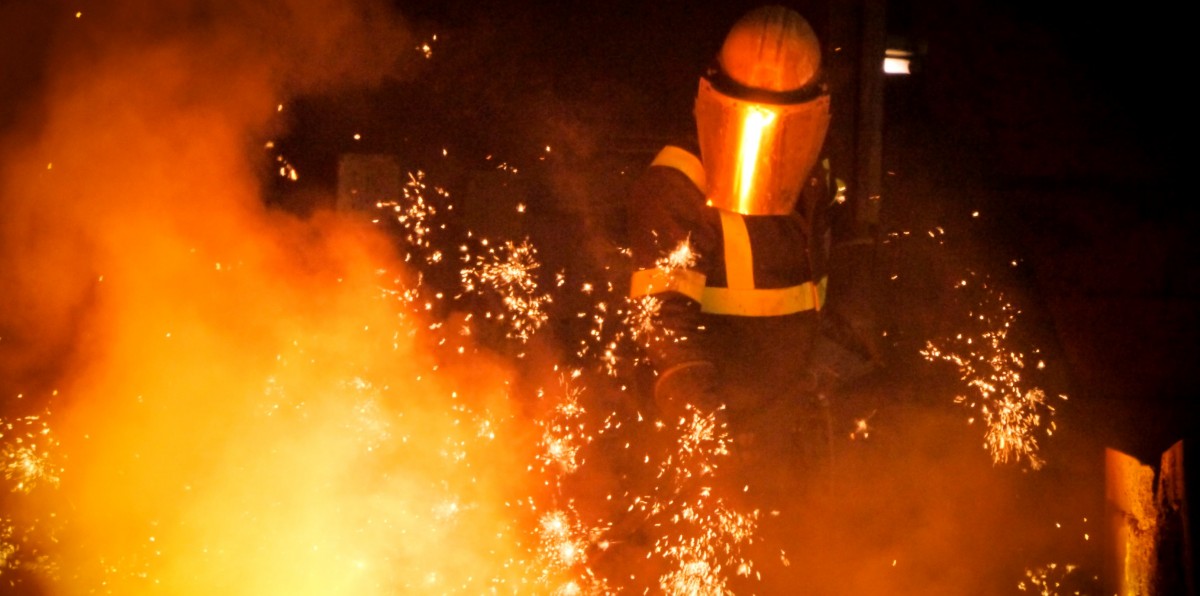
Pic of Tata Scunthorpe Unite members by Mark Thomas